

The idea behind our work

The first-output deficit

The gap between what a model, an automation or a report produces first and what someone could safely act on.

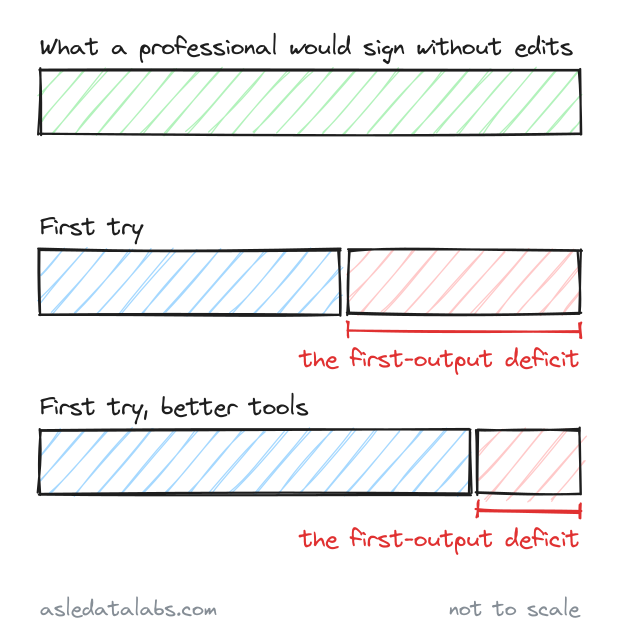
Every tool that produces work for people to rely on has one. A drafting tool’s first draft, a model’s first score and an automated report’s first run each arrive some distance short of what the person relying on it would sign. The first-output deficit is that distance. Better tools shrink it. None has closed it yet, and the reason is mostly not the tool.

Polish no longer shows the work was done

A draft used to show its gaps. A missing page reference or a total that didn’t agree with the schedule told an experienced reviewer where to look. AI output arrives polished whether or not anything behind it is right, so it reads as though the gap were closed. The deficit is still there, and reading no longer finds it. Our article on verifying AI output sets out what to check instead.

The first-output deficit: the gap between what an AI tool produces on its first try and what a professional would sign without edits, smaller with better tools but still there.

Illustrative scenarios

It’s widest where nobody redesigned the work

The deficit is smallest when the work around a tool was set up for it: someone decided what the output feeds, who acts on what it flags, what gets checked and who signs. It’s widest when output drops into work designed for people doing it by hand. Four illustrative scenarios show the pattern.

Show

A tax computation that adds up

An AI tool drafts a company’s tax computation. It uses an allowance rate that has since changed, and because every figure still adds up, nothing looks wrong.

It closes when the computation can’t reach the partner until each rate has been ticked against the current law, and the person who ticked it is named.

A risk score nobody knows what to do with

A model scores loan applications for default risk. The score arrives with no rule for what happens next, so one credit officer reads 0.4 as safe and another as a warning.

It closes when the credit policy sets the threshold, who follows up a flagged application, and how an officer records overruling the score.

Five cases, two of them real

An associate asks an AI tool for authorities on a point and gets five cases with complete citations. Two are on point, one was reversed on appeal and two don’t exist.

It closes when nothing leaves the firm until every citation has been checked against the report itself, by a named person.

A sales report with one branch in the wrong column

An automation builds the weekly sales report from branch spreadsheets. One branch changed its column order, and its sales now sit under the wrong product.

It closes when the automation checks each file against an agreed layout and holds the report for one named person when a file doesn’t match.

How it closes

It closes mostly by fixing the work

In each scenario, a better model would help less than the change around it. The deficit closes when four things are settled. Once the work is right, the tool makes it faster, and staff spend their time deciding on better information instead of proofreading a machine. That’s the principle we work by, fix the work, then make it faster, applied to AI.

  1. The decision the output feeds
  2. Who acts on what it flags
  3. The checks it has to pass
  4. The named person who signs

How to measure it

Count three things

Take a set of real tasks from one part of the work, and ask the people who would sign the result to look at each first output before anyone edits it.

The share they would sign as it stands
How often the output is ready
For the rest, the changes needed before they would, and the minutes those took
The size of the deficit
The errors that would have gone through if nobody had checked
How much of it nobody could see

Measured before and after the work around a tool changes, they show whether the change closed the gap or only moved it.

How to cite it

The first-output deficit, introduced by Eleazer Fordjour Quayson of Asle Data Labs (2026).

As a reference: Quayson, E. F. (2026). The first-output deficit. Asle Data Labs. https://asledatalabs.com/first-output-deficit

The text of this page is licensed under CC BY 4.0. You may reuse and adapt it, including commercially, if you credit Eleazer Fordjour Quayson of Asle Data Labs and link to this page.

Where we apply it

Don’t see your situation here?

These are only examples. If something in how your work runs is costing time or money, even if you can’t put your finger on it yet, the Operating Review is built to find it: a fixed fee, and a written plan of what to fix first within five working days of the last interview.

Request an Operating Review

Start with one problem

Tell us which area to look at and what’s going wrong. We’ll send a link to book a call straight away, and agree a fixed fee before any work starts.

Already know what needs fixing? Go straight to the service.

  1. We reply immediatelyWith a link to book your 30-minute call.
  2. A 30-minute callTo understand the problem and what a good result would look like.
  3. A written scope and a fixed feeBy the end of the next working day after the call. You’re under no obligation to go ahead.

Prefer email or a call? info@asledatalabs.com or +233 55 348 0047.

We use your details only to reply to you. See the privacy notice.